Monday, 31 August 2015


Level 4 in food pyramid. Source :somethingfishy.ie

The top level of the food pyramid consists of your non-essential foods such as fats, oils and sweets. This is the only level of the pyramid that should be restricted. There are no serving guidelines for this level and you should generally try to avoid foods that are high in fat or sugar. Oils that are healthy for you are generally not included as part of this levels. A good example of an oil that does not need to be limited is olive oil.


The Healthy Eating Pyramid reminds us to limit our intake of salt and added sugar. This means avoiding adding salt or sugar to food when we’re cooking or eating, and avoiding packaged foods and drinks that have salt or added sugar in the ingredients.


The average Australian already consumes too much salt and added sugar and this is linked to increased risk of diseases, such as heart disease, type 2 diabetes and some cancers.


The chart aboves sugar "availability" numbers rather than the USDA's speculative new consumption figures


Since 1970, obesity rates in the United States have more than doubled, while the incidence of diabetes has more than tripled. (Couzens C.K, 2012) 

Compared to Malaysia, Malaysia has been the most highest obesity rate among Southeast Countries which is about 44.2%.


The research was conducted by World Health Organization (WHO) in 2011


The data reflected that obesity is usually caused among city people who are well off and receive higher salaries than those who live in the countryside

Thank you for reading :) 


Level 3 in food pyramid. Photo taken from gll-getalife.com


Left Level


What's In It?

 The left side of the upper middle level consists of the dairy products in your diet. Although eggs are often found in the dairy section at your local supermarket, they are considered to be part of the meat group rather than the dairy group. Most of the fats in your diet (besides healthy oils) should come from this group.


What Should I Eat?

 You should ideally consume 2-3 servings of dairy products each day to ensure that you are adhering to a healthy diet. This level includes all dairy products like milk, soft and firm cheese and yogurt. Much like any food group, try to eat as many natural dairy products as possible to get the maximum amount of nutrients from each product. Cheese is a great choice that can be used as a healthy snack or seasoning for your salad. Ordering a cheese pizza at a restaurant generally fulfills most of your dairy needs for the day.

How Much Is a Serving?

 One serving from this upper middle/left level of the pyramid constitutes 1 cup of milk, 1.5 oz. of cheese or 2 oz. of processed cheese.


Protein and dairy foods belongs to level 3 in food pyramid. Photo from authoritynutrition.com


Right Level


What's In It?

The right side of the upper middle level consists of the meat, nut and egg products in your diet. This level includes all meat, nut and egg products like poultry, fish, beef, almonds, peanuts, walnuts, cashews and, of course, eggs. This group should be your primary source of the protein that you need in your diet every day.


What Should I Eat?

 You should ideally consume 2-3 servings of meat, nut and egg products each day to ensure that you are adhering to a healthy diet. When selecting the meats that you would like to include in your diet, try to choose as many lean cuts of meat as you can instead of beef. Fish is a great way to get many of your amino acids and essential fats. Try choosing natural meats to ensure that you are getting the most nutrients possible. Also, remember to thoroughly cook your meats to avoid any food borne illnesses.


How Much Is a Serving?

 One serving from this upper middle/right level of the pyramid constitutes 2-3 oz. of heated meat or fish, 1 cup of beans, 2 eggs or 4 tbsp. of peanut butter.

Left and right in Pyramid Food level 2. Photo by gll-getalife.com


Left Level 


What's In It?


The left side of the lower middle layer consists of the vegetables in your diet. These vegetables are not limited to leafy green vegetable like other programs but include all vegetables that are available. In addition to raw vegetable and the like, this level also includes vegetable juices like mixed juice and tomato juice.


What Should I Eat?

You should ideally consume 3-5 servings of vegetables each day to ensure that you are adhering to a healthy diet. When selecting your vegetables, be sure to eat as many raw ones as you can. Raw vegetables contain all of the nutrients that typically come in the plant while canned or cooked vegetables tend to robbed of most of their nutrients.


How Much Is a Serving?


One serving from this middle/left level of the pyramid constitutes 1 cup of raw vegetables, 1/2 cup of chopped or cooked vegetables or 3/4 cup of juice.


Fruits and vegetables in level 2 of food pyramid. Photo from district.eastchesterschools.org


Right Level


What's In It?


 The right side of the lower middle layer consists of the fruits in your diet. In addition to raw fruits and the like, this level also consists of fruit juices like apple, grape and orange juice. Remember that this level also consists of berries like strawberries and raspberries.


What Should I Eat?


 You should ideally consume 2 to 4 servings of fruit each and every day to ensure that you are adhering to a healthy diet. When choosing fruit juice, look for varieties that contain no added sugar. Excellent varieties of natural fruit juices that contain no preservatives are widely available. If you have the time and resources, you may even consider making your own fruit juice from fresh fruit. In fact, "juicers" can be readily purchased at department stores and can be used to make vegetable juice as well.


How Much Is a Serving


 One serving from this middle/right level of the pyramid constitutes a single medium sized piece of fruit (apple, mango, orange, banana), 1/2 cup of canned, heated or sliced fruit or 3/4 cup of fruit juice


Level 1 of Food Pyramid. Photo from gll-getalife.com


What's In It?

The bottom level of the food pyramid consists of bread, cereal, rice and pasta.


Complex Carbohydrate


What Should I Eat?

You should consume 6-11 servings from this bottom level. When selecting your bread, make sure that it is whole grain and as natural as possible. A good way to select bread is to avoid products that show high fructose corn syrup as one of the first 5 ingredients. Ideally, bread should have as few ingredients as possible to be truly natural.


How Much Is a Serving? 

One serving from this bottom level constitutes a single slice of bread, 1 oz. of dry cereal and 1/2 cup of heated cereal, rice or pasta. Consuming 6-11 servings from this level of the pyramid should be quite simple during the day. If you eat 2 slices of toast and a bowl of cereal during breakfast, you have already fulfilled half of your bottom level requirement for the day.


Next, we will be discussing about level 2 in food pyramid.
See you in next post!


Hye everyone. We meet again. In this entry, I want to present the most crucial parts when discussing about healthy food which is food pyramid!

First and the foremost, what is food pyramid? Do you ever heard about this term before? Oh yes. We have learnt about it since primary school. Lets revise :) 

The definition of food pyramid is a nutritional diagram in the shape of a pyramid, especially (in the US) the Food Guide Pyramid  representing the optimal number of servings to be eaten each day from each of the basic food groups.

The examples of food pyramid by women-info.com

Prof Dr Gayene (1999) said that it is recommended to have 6-11 servings daily for food from the base of Food Pyramid. Products from next level of pyramid can be used for 2-4 servings per day and products from pyramid apex should be avoided or used very rare.


The first food pyramid was published in Sweden in 1974. The food pyramid introduced by the United States Department of Agriculture in the year 1992 was called the "Food Guide Pyramid". It was updated in 2005 and then replaced by MyPlate in 2011.


Now, let us watch the video from youtube by meiermaa (1st Grade Students)


Dont forget to take note important information for your future :)

See you soon ! 


Imagining that you are in the 5 star seafood restaurant, what types of seafood will be your choice? What is your preference? Tasty or healthy? 

If you still confuse, now I will guide you to decide. Let's start reading :) 


1. ALBACORE TUNA


The protein content in albacore tuna is high. One can provides 40.6 g, or 81 percent of the 65 g ADA daily value. Protein is a nutrient that improves energy metabolism. It slows the absorption of carbohydrates into the bloodstream and prevents sudden increases in blood glucose that cause energy peaks and valleys. Protein also provides the amino acids your body needs to build enzymes that catalyze most chemical reactions in the body.


Albacore Tuna can lowers blood cholesterol levels and helps maintain your brain and joints.
Photo by 
huffingtonpost.com

Albacore tuna has about the same amount of protein as meat and poultry, but when it's packed in water, it has half the calories and one-fourth the total fat as the average amount in beef and chicken.


Grilled Albacore Tuna. Photo by bbcgoodfood.com

It slows the absorption of carbohydrates into the bloodstream and prevents sudden increases in blood glucose that cause energy peaks and valleys. Protein also provides the amino acids your body needs to build enzymes that catalyze most chemical reactions in the body.


2. Salmon

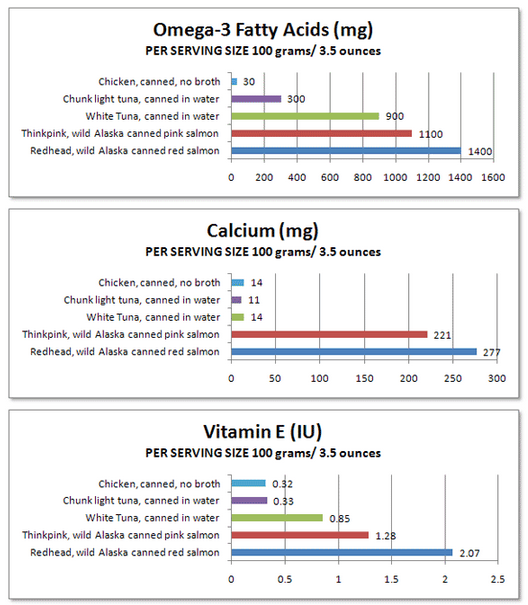
Salmon (along with sardines, mackerel, herring, halibut, black cod and Arctic char) is a sustainable source of omega-3 fish. It is an excellent source of high-quality protein, vitamins and minerals (including potassium, selenium and vitamin B12) but it is their content of omega-3 fatty acids that receives the most attention.


Salmon's meat is orange-reddish in colour. Photo by http://swisspaleo.ch/ 


Below are the Nutrional Comparison Chart create Pure Alaska Salman Co. in Washington:


3. OYSTERS

A cup of raw oysters contains 650 percent of the recommended daily value of zinc. This essential trace element is only needed in small amounts, but it is important to the system. The main function of zinc is to boost the body's immune system, which is advantageous for cold prevention.

Oysters can positively impact heart health in a variety of ways, but primarily, the high levels of omega-3 fatty acids versus omega-6 fatty acids are what impact the cholesterol so greatly


Oysters are complete proteins, which means they contain all of the essential amino acids. You do not have to combine them with any other foods to create a complete protein.


That's all for now. Thankyou :) 


Hye everyone! We meet again :) Now, I want to let you guys know about the lists of most healthiest vegetables in the world.

Lets proceed...!


1. KALE


Kale can provide you with some special cholesterol-lowering benefits if you will cook it by steaming. The fiber-related components in kale do a better job of binding together with bile acids in your digestive tract when they've been steamed. When this binding process takes place, it's easier for bile acids to be excreted, and the result is a lowering of your cholesterol levels. Raw kale still has cholesterol-lowering ability—just not as much.
Kale is one of the healthiest vegetables around and one way to be sure to enjoy the maximum nutrition and flavor from kale is to cook it properly. 

2. SPINACH


Dark leafy greens like spinach are important for skin and hair, bone health, and provide protein, iron, vitamins and minerals.

The possible health benefits of consuming spinach include improving blood glucose control in diabetics, lowering the risk of cancer, lowering blood pressure, improving bone health, lowering the risk of developing asthma and more.


Spinach is a super food loaded with tons of nutrients in a low calorie package.


3. CARROT

Forget about vitamin A pills. With this orange crunchy powerfood, you get vitamin A and a host of other powerful health benefits including beautiful skin, cancer prevention, and anti-aging. Read how to get maximum benefits from this amazing vegetable.


Those are some advantages of consuming carrots:-

1. Improves vision
Western culture’s understanding of carrots being “good for the eyes” is one of the few we got right. Carrots are rich in beta-carotene, which is converted into vitamin A in the liver. Vitamin A is transformed in the retina, to rhodopsin, a purple pigment necessary for night vision.

Beta-carotene has also been shown to protect against macular degeneration and senile cataracts. A study found that people who eat the most beta-carotene had 40 percent lower risk of macular degeneration than those who consumed little.


Sweet and crunchy carrots are notably rich in anti-oxidants, vitamins and dietary fiber.


2. Helps prevent cancer
Studies have shown carrots reduce the risk of lung cancer, breast cancer and colon cancer. Researchers have just discovered falcarinol and falcarindiol which they feel cause the anticancer properties.

Falcarinol is a natural pesticide produced by the carrot that protects its roots from fungal diseases. Carrots are one of the only common sources of this compound. A study showed 1/3 lower cancer risk by carrot-eating mice.


4. BROCCOLI


Researchers from the University of Illinois wrote in Nutrition and Cancer that lightly steamed broccoli can significantly reduce your risk of developing cancers (steaming it slightly does not destroy the enzyme myrosinase). However, if you overcook it the health benefits are undermined. 


Green Broccoli


Eating broccoli may help prevent osteoarthritis. A UK study found that sulforaphane, a compound found in broccoli and other cruciferous vegetables such as cabbage and Brussels sprouts, could help fight osteoarthritis, the most common form of arthritis.


5. BRUSSELS SPROUTS

Brussels sprouts can provide you with some special cholesterol-lowering benefits if you will use a steaming method when cooking them. The fiber-related components in Brussels sprouts do a better job of binding together with bile acids in your digestive tract when they've been steamed. 


Brussels sprouts may have unique health benefits in the area of DNA protection


100 studies in PubMed (the health research database at the National Library of Medicine in Washington, D.C.) that are focused on Brussels sprouts, and over half of those studies involve the health benefits of this cruciferous vegetable in relationship to cancer.

Now, I pretty sure that you guys has well-versed about what is the vegetables that most beneficial to your health right? 

See you! 

Sample Text

Powered by Blogger.

Popular Posts

Popular Posts

Followers